

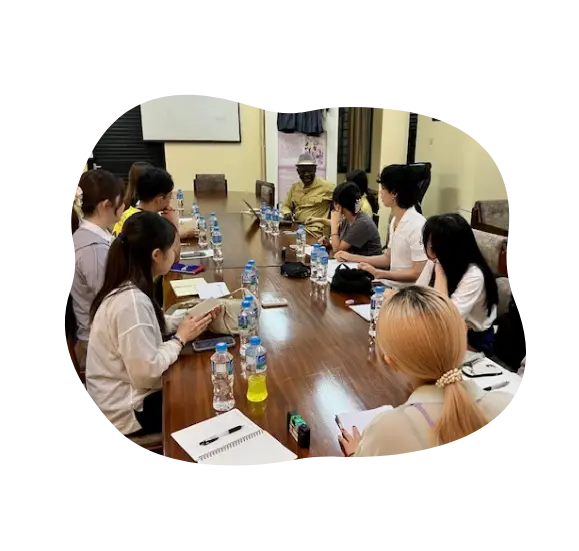



This program aims to develop future global leaders who can address environmental challenges through international collaboration between Japan and Africa. It combines coursework, short-term study programs, and field-based training to foster practical skills and intercultural understanding.
The program is open to undergraduate and graduate students at Sophia University and its partner institutions in Africa.
1.Co-learning Courses (Lectures):
Students learn about Japanese and African societies, cultures, and languages through COIL-based interactive classes conducted in English and/or French.
2.Short-term Training:
Students participate in programs such as “Learn from Africa” (outbound) and the “Summer Session” (inbound) to gain hands-on experience.
3.International Collaborative Practice / Mid- to Long-term Study Abroad:
Students will deepen their practical learning through field projects, volunteer activities, internships, and exchange programs.
Sophia–Africa Future Initiatives for Collaborative Solutions (SAFICS) is an introductory course focusing on Japan–Africa relations. It includes lectures, guest speakers, and COIL sessions with African universities. This course is a core requirement for the Japan–Africa Collaborative Practice Program Certificate.
Students who complete the designated courses and meet academic requirements will receive a digital certificate and open badge titled Japan–Africa Collaborative Practice Program.
*What are Open Badges: They are digital certificates that can be issued and shared online to verify skills. They allow you to prove online that you have achieved certain outcomes, such as learning or obtaining qualifications.
The program collaborates with seven African universities, including Stellenbosch University (South Africa), the Egypt–Japan University of Science and Technology and others. It also partners with organizations such as JICA and the African Development Bank (AfDB).
Participants will develop:
・Multilingual communication skills for cross-cultural collaboration
・The ability to identify and address global environmental issues
・Leadership and teamwork skills through international cooperation
Detailed information and application guidelines for each program component (course enrollment, short-term training, exchange programs, certification, etc.) will be posted on the Sophia University student portal My Sophia or on the university website.
It is perfectly natural to feel some concern about traveling abroad. Our program provides comprehensive pre-departure training covering safety measures, health management, and cross-cultural understanding. During your stay, you will also be supported through a strong network in cooperation with partner universities and institutions in Africa.
In addition, all participants are required to obtain overseas travel insurance, and an emergency contact system and safety monitoring protocols are in place. Previous participants have completed their programs safely and have gained rich and valuable learning experiences.
We kindly ask parents and guardians to provide emotional and health-related support so that students can focus on their learning with peace of mind. From an educational standpoint, our university supports students’ study abroad experiences as opportunities for growth, except in cases where serious safety or well-being issues arise.
The abilities students gain from studying abroad begin to develop during the preparation phase—through gathering information, completing necessary procedures, and taking responsibility for their own learning. While abroad, they will face challenges arising from different cultures and environments, and we hope they will learn to solve problems independently while making use of available support.
We understand that guardians may sometimes feel anxious; however, we would greatly appreciate your supportive stance of “watching over” your student’s growth from a distance.
If communication between the student and the host university becomes difficult, the student can consult with our office, which will assist in resolving the issue. We appreciate your understanding and cooperation in this regard.
Yes. Eligible students may receive scholarships that partially cover travel and living expenses during their stay abroad. In addition to the JASSO (Japan Student Services Organization) scholarships funded by the Ministry of Education, Culture, Sports, Science and Technology (MEXT), university-based financial support may also be available.
Please refer to the application guidelines or contact the program office for detailed information.
Africa is undergoing rapid economic growth and social transformation, attracting global attention in areas such as environment, energy, education, and governance. Collaboration between Japan and Africa plays a vital role in achieving a sustainable and inclusive society.
This program provides students with opportunities to engage in practical, hands-on experiences of “learning and creating together” with African partners, helping them grow into future global leaders capable of contributing to international cooperation and mutual understanding.
If you have any questions or concerns about the Japan-Africa Collaboration Program, please contact us here.